Not every factory needs a massive heavy-duty crane. For many workshops, warehouses, and light industrial facilities, a single girder EOT crane is exactly the right fit — practical, cost-effective, and built for reliable everyday use. Whether you are handling machine parts, moving raw materials, or managing light assembly operations, this crane gets the job done without the complexity or cost of larger systems.
But with several types, configurations, and customization options available, choosing the right single girder EOT crane for your facility requires some understanding. This guide breaks it all down — what it is, how it works, the different types, key features, and everything you need to know before making a purchase decision.
What Is a Single Girder EOT Crane?
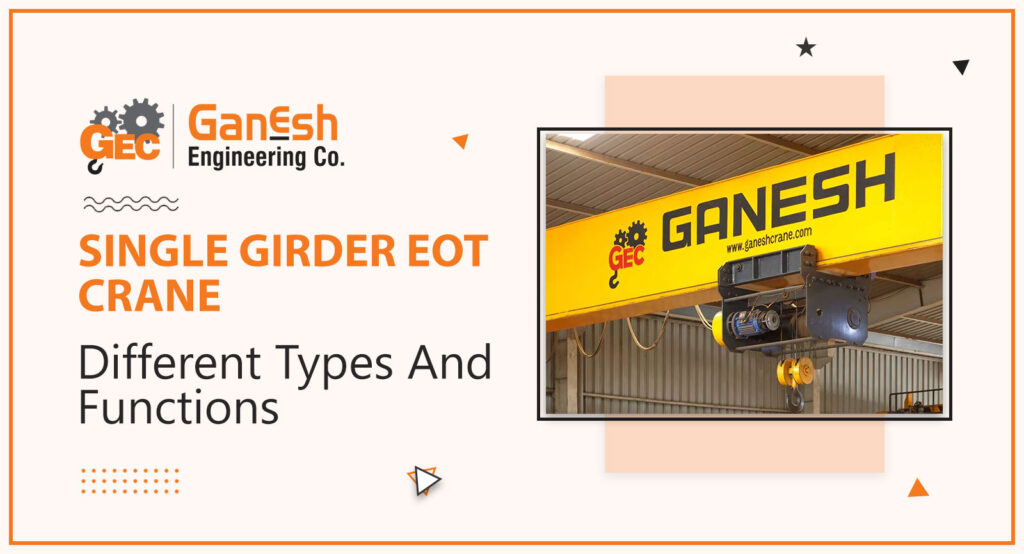
A single girder EOT crane is a type of Electric Overhead Travelling crane that uses one main bridge beam — called a girder — to span across a bay or workspace. An electric hoist travels along the bottom flange of this single beam, lifting and lowering loads as required.
The bridge itself runs along two runway rails fixed to the building structure, moving the load lengthwise across the facility. Together, the hoist, bridge, and runway give the crane three-axis movement — up and down, across the bay, and along the length of the building.
The main girder is typically fabricated from rolled steel sections in U or I shapes, giving it strength without unnecessary weight. This design keeps the overall structure lighter and more compact compared to double girder models.
Quick specs at a glance:
- Lifting capacity: 0.5 ton to 20 tons (standard range)
- Span: Up to approximately 20 meters
- Maximum lifting height: Up to 6 hours of operation per duty cycle
- Best suited for: Light to moderate duty applications
Types of Single Girder EOT Cranes
Single girder cranes are broadly classified into two main types based on how the bridge runs on the runway structure.
1. Top-Running Single Girder EOT Crane
In a top-running configuration, the end trucks (wheels) of the crane bridge run on top of the runway rails. The rails are mounted on the top flange of runway beams attached to the building columns or walls.
This type offers better span capability — typically up to 65 feet — and can handle higher lifting capacities. Because the crane sits above the rails, it uses the full available headroom in the building more efficiently.
Top-running single girder cranes are constructed using channels and rolled beams and are ideal for facilities where load requirements are moderate but where span and headroom matter.
Best for: Medium spans, higher capacity within the single girder range, and facilities with adequate roof height.
2. Under-Running (Underhung) Single Girder EOT Crane
An under-running crane — also called an underhung crane — has its end trucks hanging below the bottom flange of the runway beams. Instead of sitting on top of the rails, the crane hangs from them.
This configuration makes it excellent for maximizing the use of floor space and ceiling height. Because the runway beams can be suspended from the roof structure, there is no need for dedicated floor-level support columns — a major advantage in facilities with limited floor space or complex layouts.
Under-running cranes are highly maneuverable and work well in areas with multiple interconnected bays or transfer systems.
Best for: Facilities with low headroom, limited floor space, or complex material flow paths that require crane movement between bays.
Key Features of a Single Girder EOT Crane
A well-manufactured single girder EOT crane includes the following standard features:
- Single rolled steel bridge girder — lightweight yet structurally capable for moderate loads
- Electric wire rope hoist or chain hoist mounted on the bottom flange of the girder
- Disc brakes with DC (direct current) control for precise, smooth stopping of all motions
- Hook with safety latch to prevent accidental load release during lifting
- Upper and lower limit switches on the hoist to prevent over-hoisting and over-lowering
- Pendant push-button station for easy floor-level crane operation
- Corrosion-resistant body construction for reduced maintenance needs
- Compact, lightweight design that places lower loads on the building structure
- Optional wireless remote control for improved operator flexibility
- Electrical panel with overload protection, MCB, and emergency stop
Benefits of a Single Girder EOT Crane
The single girder design is popular for good reason. Here is what makes it a smart choice for the right application:
- Lower Initial Cost: Single girder cranes cost significantly less to manufacture, supply, and install compared to double girder models. This makes them the go-to option for budget-conscious projects.
- Lighter Structural Load: Because the crane itself weighs less, the supporting building structure does not need to be as heavy or reinforced. This saves on civil and structural costs.
- Simpler Installation: Fewer components mean a faster and more straightforward installation process, reducing commissioning time.
- Space Efficiency: The compact design takes up less headroom, which is especially valuable in buildings with low ceiling heights.
- Easier Maintenance: With fewer parts and simpler mechanisms, routine servicing is quicker and less expensive.
- Good Maneuverability: Single girder cranes — especially underhung types — can be integrated into multi-bay transfer systems for flexible material flow.
- Sufficient for Most Light-Duty Needs: For capacities up to 20 tons and moderate operational cycles, the single girder design performs reliably without over-engineering.
Applications of Single Girder EOT Cranes
Single girder EOT cranes are widely used across industries where lifting requirements are moderate and operational cycles are not continuous:
- Light Engineering Workshops — lifting machinery components, dies, fixtures, and tooling
- Warehouses and Storage Facilities — moving packaged goods, pallets, and raw material bundles
- Automobile Service Centers — engine lifts, body panel handling, and component transfers
- Textile and Garment Units — moving fabric rolls, yarn cones, and machinery
- Pharmaceutical and Food Processing Plants — hygienic lifting of tanks, vessels, and equipment
- Cement and Construction Material Stores — loading and unloading bags and building material
- Electronics and Electrical Manufacturing — moving transformers, panels, and switchgear
- Agricultural Equipment Plants — handling tractor parts, implements, and assemblies
Essentially, any facility that needs overhead lifting without the volume or weight demands of a steel plant or heavy foundry will find the single girder EOT crane perfectly suited to its needs.
How to Choose the Right Single Girder EOT Crane
Buying the right crane means matching the machine to your actual operational needs. Here are the key factors to evaluate:
- Load Capacity: Define your heaviest regular lift. Choose a crane rated above that figure with a safety margin. Remember, the standard test load is 125% of the Safe Working Load (SWL).
- Span Required: Measure your bay width carefully. The crane span determines how far the hoist can travel across the workspace.
- Hook Height: Confirm the minimum headroom available and how high the load needs to travel. Under-running cranes offer a slight advantage here.
- Top-Running or Under-Running: Choose top-running for better capacity and longer spans. Choose under-running for low-headroom buildings or multi-bay layouts.
- Duty Class: Light, occasional use is suitable for M1–M2 class. More regular industrial use will need M3–M4 rated equipment.
- Hoist Type: Wire rope hoists are standard for heavier loads. Chain hoists work well for lighter, lower-height applications.
- Customization Needs: If your facility needs specific platform layouts, walkways, or non-standard configurations, confirm the manufacturer can accommodate these before ordering.
- IS Code Compliance: Ensure the crane is built to IS807 and IS3177 standards for safety and quality assurance.
Why Single Girder EOT Crane Manufacturers Matter
The quality of the crane you receive depends almost entirely on who builds it. Partnering with experienced Single Girder EOT Crane Manufacturers means your equipment is designed for real-world industrial conditions — not just on paper.
A quality manufacturer will use certified IS-2062 grade steel, source reputed brand motors and electrical components, perform load testing before dispatch, and offer proper documentation including test certificates and wiring diagrams. They will also provide trained engineers for installation and commissioning, and support you with spare parts and service after the sale.
Ganesh Engineering Co., based in Ahmedabad, Gujarat, has been manufacturing and supplying material handling equipment since 2004. The company offers a complete range of single girder EOT cranes — with options for top-running and under-running configurations, multiple capacity ratings, and full customization support. Their team works directly with clients to understand facility requirements and deliver cranes that are ready to perform from day one.
When evaluating any supplier, ask about their manufacturing facility, quality certifications, client references, and after-sales service policy. The cheapest crane on paper is rarely the most economical crane over its working life.
Maintenance Tips for Single Girder EOT Cranes
Single girder cranes are relatively easy to maintain, but skipping routine checks leads to unplanned breakdowns. Keep your crane in top condition with these practices:
- Daily checks: Inspect the hook and safety latch, test the pendant push-button controls, and visually check the wire rope or chain for damage before each shift.
- Weekly checks: Listen for unusual sounds during all motions — grinding, squealing, or jerking often signals brake or wheel wear.
- Monthly checks: Test all limit switches (upper, lower, and travel). Verify that the emergency stop cuts power instantly. Lubricate wheels, gearbox, and the rope sheaves as per the manufacturer’s schedule.
- Quarterly checks: Inspect the electrical panel for dust, loose terminals, and signs of overheating. Check runway rail alignment and end stopper condition.
- Annual load test: Have a certified engineer conduct a full load test at 125% SWL and issue a fresh test certificate. This is mandatory for continued safe operation.
- Replace wire ropes proactively: Do not wait for wire rope failure. If you see broken strands, kinks, or corrosion, replace immediately.
Conclusion
A single girder EOT crane is one of the most practical and cost-efficient overhead lifting solutions available for light to moderate industrial applications. It delivers reliable performance, covers the full working area of your facility, and does so at a fraction of the cost and complexity of heavier crane systems.
From top-running models built for longer spans to compact underhung cranes designed for low-headroom facilities, there is a single girder EOT crane suited to almost every light industrial application.
If you are planning to install a new crane or replace aging equipment, invest the time in understanding your exact requirements and choosing a manufacturer who can deliver quality, compliance, and long-term support.
Frequently Asked Questions (FAQs)
Q1. What is a single girder EOT crane used for?
A single girder EOT crane is used for light to moderate lifting tasks in workshops, warehouses, textile units, food processing plants, automobile service centers, and similar facilities. It handles loads typically ranging from 0.5 ton to 20 tons.
Q2. What is the maximum capacity of a single girder EOT crane? Standard single girder EOT cranes are rated up to 20 tons of lifting capacity. For higher capacities or longer spans, a double girder EOT crane is the more appropriate choice.
Q3. What is the difference between a top-running and an under-running single girder EOT crane?
A top-running crane travels on top of runway rails and offers better span and capacity. An under-running (underhung) crane hangs from the runway beams, making it ideal for low-headroom spaces and multi-bay material flow systems.
Q4. How long does a single girder EOT crane last?
With proper maintenance and operation within its rated duty class, a quality single girder EOT crane can provide reliable service for 15 years or more.
Q5. Is a single girder EOT crane suitable for outdoor use?
Standard single girder cranes are designed for indoor use. Outdoor installation requires a weatherproof enclosure, corrosion-resistant coating, and appropriate motor protection ratings — confirm these requirements with your manufacturer before ordering.
Q6. Can a single girder EOT crane be customized?
Yes. Most manufacturers offer customization for span, hook height, control type, capacity, duty class, and platform arrangements. Customization is time-intensive, so communicate your requirements clearly and early in the process.
Q7. How often should a single girder EOT crane be serviced?
Daily pre-shift checks are recommended. Monthly inspections of limit switches and electrical systems, quarterly runway and panel checks, and an annual certified load test at 125% SWL form a complete maintenance schedule.
